A thermal camera image can look colorful and sharp while still hiding small temperature differences. That is why buyers who care about subtle patterns should look beyond pixel count and ask about NETD. In a thermal-camera specification, NETD describes sensitivity to small differences in scene temperature. It helps answer a focused question: how much thermal contrast can the imaging system distinguish under stated test conditions?
NETD is important, but it is not a one-number verdict on image quality. Resolution, optics, working distance, focus, emissivity, reflections, frame rate, processing, and the inspection environment all influence what the operator can actually see. This guide explains how to read a NETD thermal camera specification, where sensitivity adds value, and where a lower number cannot solve the measurement problem by itself. For the broader specification framework, start with our high-resolution thermal camera guide.
How this guide was prepared: We cross-checked manufacturer guidance from FLIR and Fluke with official MILESEEY product and Support information. Product values below are published specifications, not results of independent laboratory testing.
NETD: the quick answer
NETD stands for noise-equivalent temperature difference. It is commonly stated in millikelvin, or mK. In comparable test conditions, a lower NETD indicates that a thermal imaging system can separate smaller temperature differences from its own image noise. FLIR's thermal-sensitivity guidance describes NETD as a way to compare the smallest temperature differences a system can resolve.
That definition needs two qualifications. First, NETD is a system specification measured under defined conditions, not a promise that every field image will reveal the same small difference. Second, sensitivity is not the same thing as temperature-measurement accuracy. A camera may display fine relative contrast yet still require careful setup to support a trustworthy quantitative reading.
What a lower NETD can change in the image
Finer tonal separation in low-contrast scenes
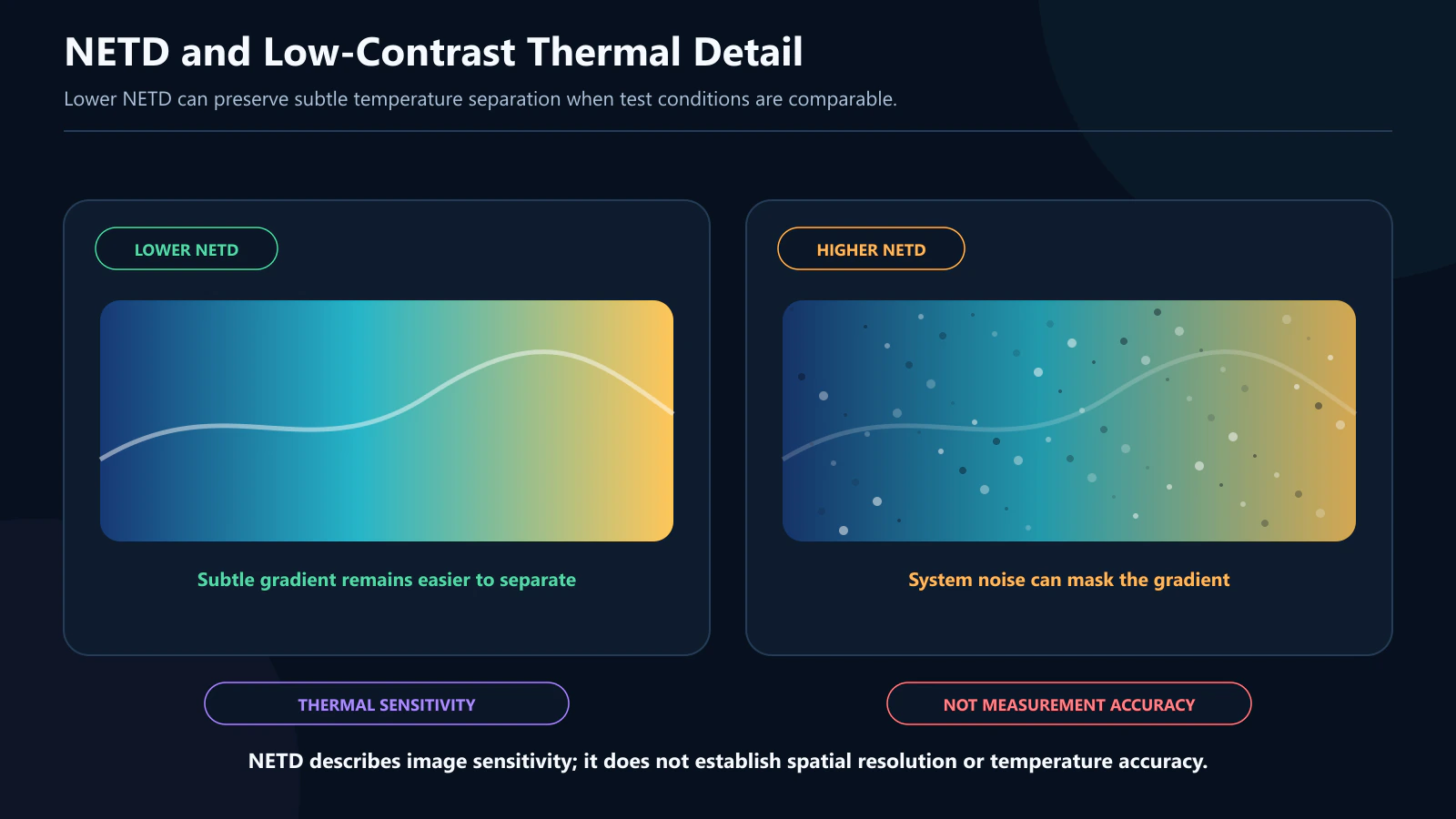
When neighboring surfaces are only slightly different in temperature, a more sensitive system may show smoother gradients and more separation between close thermal values. That can help an operator recognize a faint boundary or decide where to investigate more closely. The benefit is most relevant in low-contrast scenes; it is less decisive when the target is already dramatically hotter or colder than its surroundings.
Less apparent noise does not mean more spatial detail
Sensitivity and resolution solve different problems. NETD concerns the separation of small temperature differences. Native infrared resolution concerns how many detector pixels sample the scene. A small object can remain undersampled even when the camera has strong sensitivity. Conversely, a high pixel count cannot recover a temperature difference that is buried in noise. Our thermal camera resolution comparison explains why sensor pixels, display pixels, and digital zoom should not be treated as interchangeable.
NETD does not establish measurement accuracy
Accuracy addresses how closely a reported temperature corresponds to the target's temperature under specified conditions. Sensitivity addresses the ability to distinguish small differences. The two interact with calibration and measurement technique, but one cannot be substituted for the other. If a purchasing decision depends on a critical absolute temperature, review the relevant measurement specification, its test conditions, and the required procedure separately from NETD.
A thermal-sensitivity priority matrix
The matrix below is a decision aid, not a pass/fail standard. Use it to decide how much weight NETD should receive relative to the rest of the imaging system.
| Inspection situation | Typical thermal contrast | Why sensitivity may matter | What to check at the same time |
|---|---|---|---|
| Surface pattern near a building detail | Often subtle | Fine gradients may help locate an area for further investigation | Weather, indoor-to-outdoor temperature difference, reflections, and confirmation with another method |
| HVAC supply-and-return comparison | Low to moderate | Smooth tonal separation can make distribution patterns easier to interpret | Airflow conditions, surface material, working distance, and a repeatable baseline |
| Electrical survey with an obvious hot connection | Moderate to high | NETD may be less limiting when the anomaly already has strong contrast | Load, safe access, target size, emissivity, and comparison with similar components |
| Mechanical trend inspection | Depends on load and baseline | Sensitivity can help reveal gradual changes when the procedure is consistent | Repeatable angle, distance, operating state, focus, and saved context |
A thermal pattern is evidence for investigation, not an automatic diagnosis. For example, a cool surface pattern may be consistent with moisture-related cooling, but a thermal camera does not directly see water inside a wall. Confirm the cause with an appropriate inspection method.
How to compare NETD specifications responsibly
1. Confirm that the numbers use comparable conditions
NETD can be influenced by detector temperature, optics, image processing, measurement method, and the conditions used for the published test. A small numerical difference is not automatically meaningful if two vendors report under different conditions. Look for a complete official specification and ask for clarification when the test basis is unclear.
2. Pair sensitivity with native infrared resolution
Count detector pixels, not just display pixels. Native infrared resolution determines how many independent samples form the thermal image. Display resolution determines how the image is presented on the screen. Digital zoom enlarges existing samples; it does not create new detector information. The useful choice depends on target size and working distance, not on a number in isolation.
3. Review frame rate and focus for the actual task
Frame rate describes how often the image updates, while NETD describes thermal sensitivity. A higher update rate can make scanning and moving scenes feel more fluid, but it should not be read as proof of lower NETD. Likewise, a poorly focused image can hide edges and small targets even when the detector is sensitive. FLIR's thermal camera specification overview treats sensitivity and resolution as distinct selection factors.
4. Match measurement range to expected surfaces
A camera also needs a measurement range that covers the surfaces in the job. Choosing a very wide range does not automatically improve sensitivity at ordinary temperatures, and sensitivity does not extend the stated measurement limits. Use our thermal camera temperature range guide to separate range, operating environment, and image-quality decisions.
Field conditions that can outweigh NETD
Emissivity and reflected energy
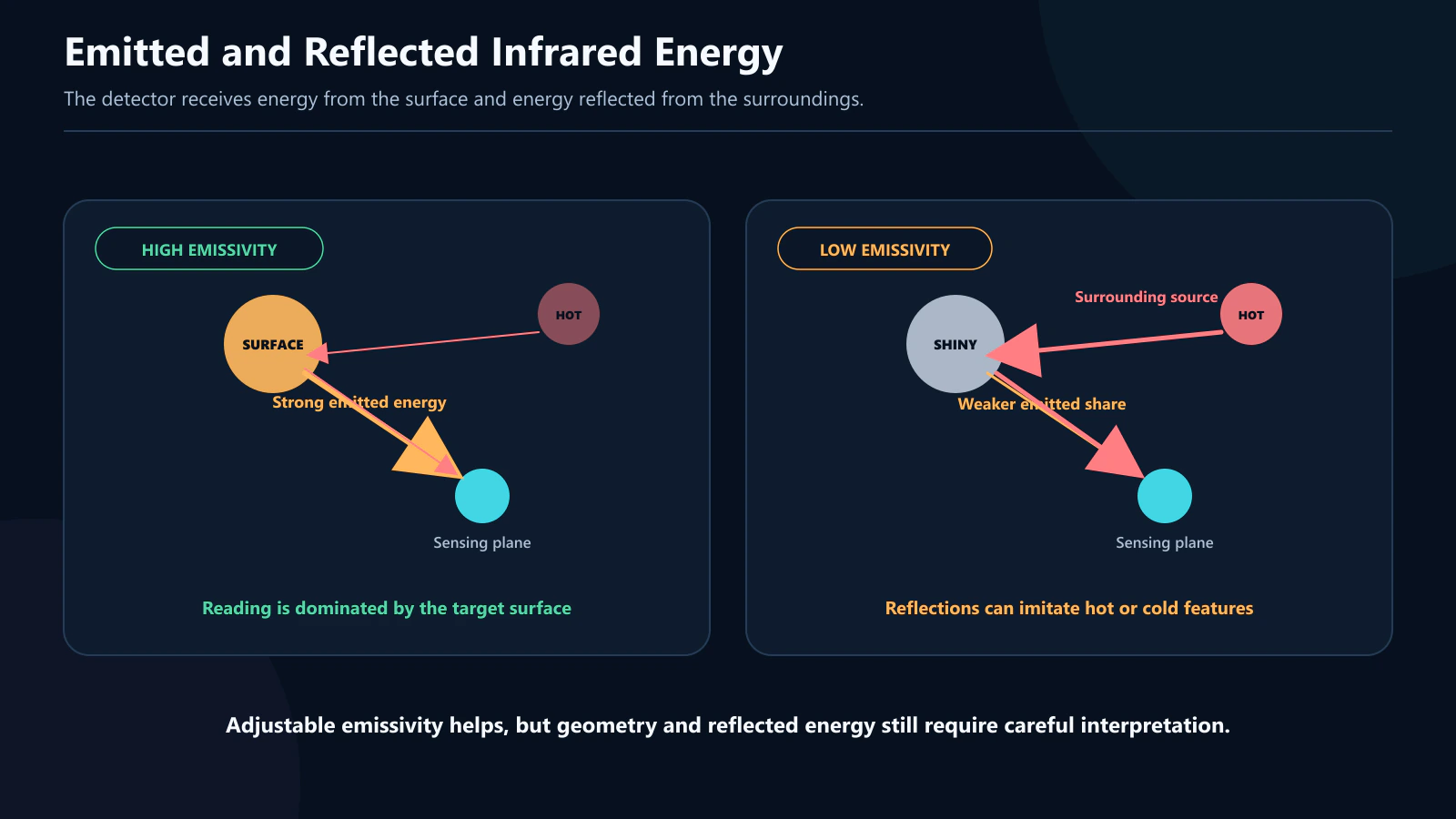
Thermal cameras detect infrared energy reaching the detector. The reading can include emitted energy from the target and reflected energy from the surroundings. Low-emissivity or shiny surfaces are especially difficult because they can reflect a person, sky, machinery, or another hot object. Fluke's guidance on reflective surfaces shows why an apparent hot or cold area may be a reflection rather than the target's condition. Adjustable emissivity is useful, but entering a value does not eliminate every source of uncertainty.
Target size, distance, and viewing angle
A target must cover enough detector pixels for useful interpretation. As distance grows, the target occupies fewer pixels. An oblique viewing angle can also make the useful surface area smaller and increase reflection problems. Fluke's thermography principles booklet distinguishes field of view from the smaller instantaneous field represented by a detector element. In practice, move closer when it is safe, focus carefully, and avoid treating an enlarged on-screen image as added measurement detail.
Scene and operating stability
Wind, sunlight, recent equipment shutdown, changing loads, and rapid environmental transitions can alter surface temperatures. A highly sensitive camera may faithfully reveal those effects without telling the operator which one caused the pattern. Record conditions, compare like with like, and repeat the inspection when the scene is not representative.
TR256A as a documented NETD example
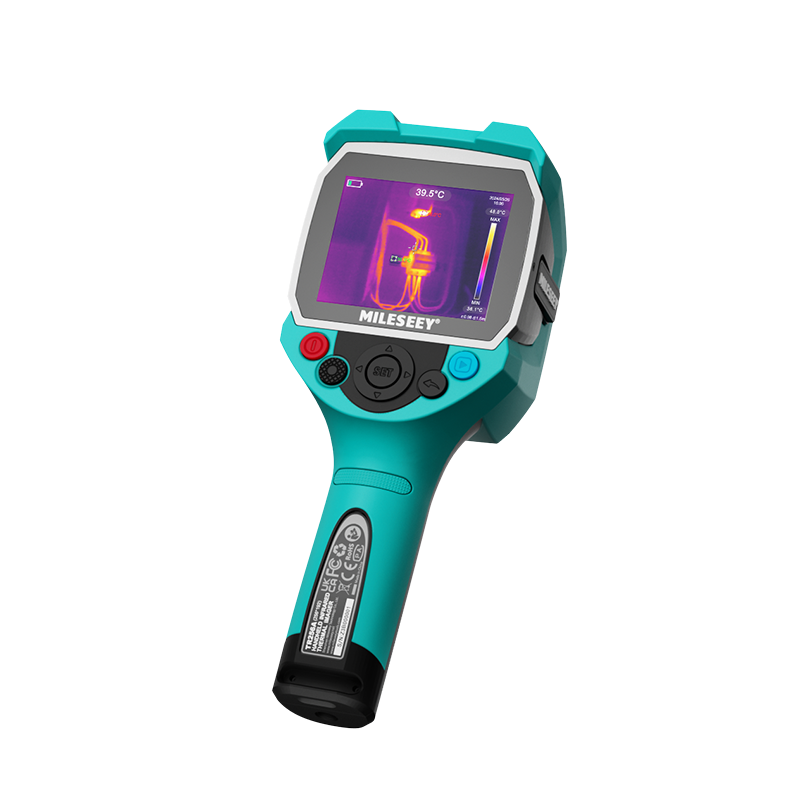
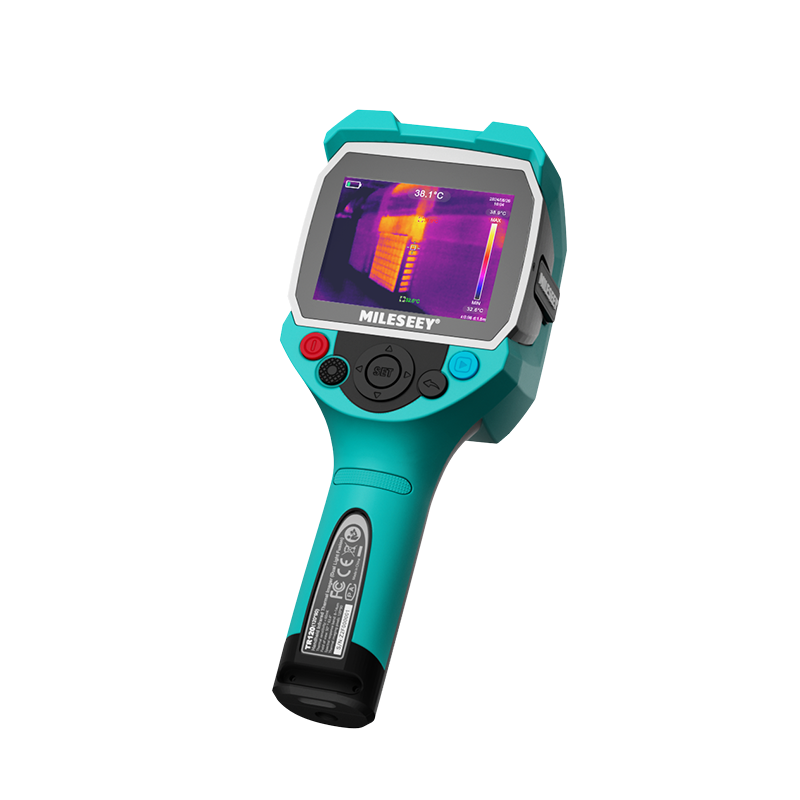
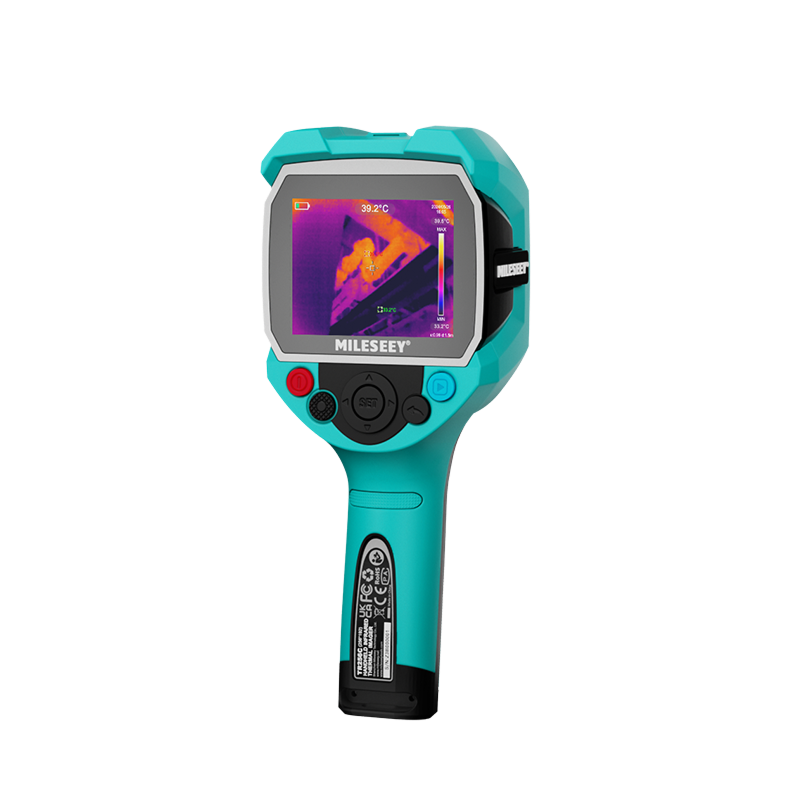
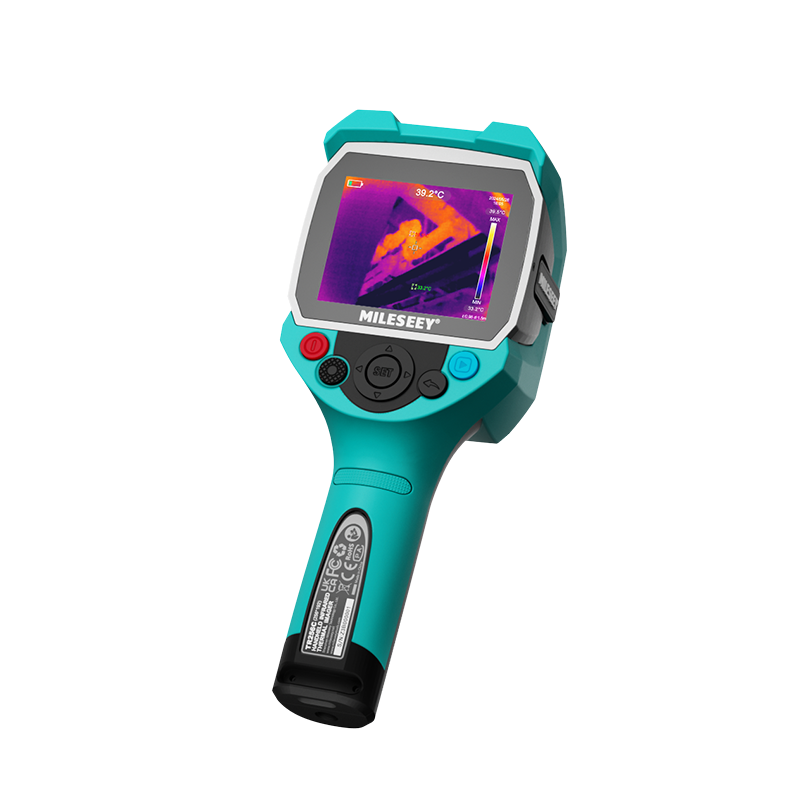
The official TR256A Support specifications list NETD at no more than 50 mK. The same official information lists a 256×192 native infrared detector, 12 µm pixel pitch, an 8–14 µm spectral range, and a 50 Hz frame rate. Those values describe different parts of the imaging chain: sensitivity, detector sampling, detector geometry, spectral response, and image updates.
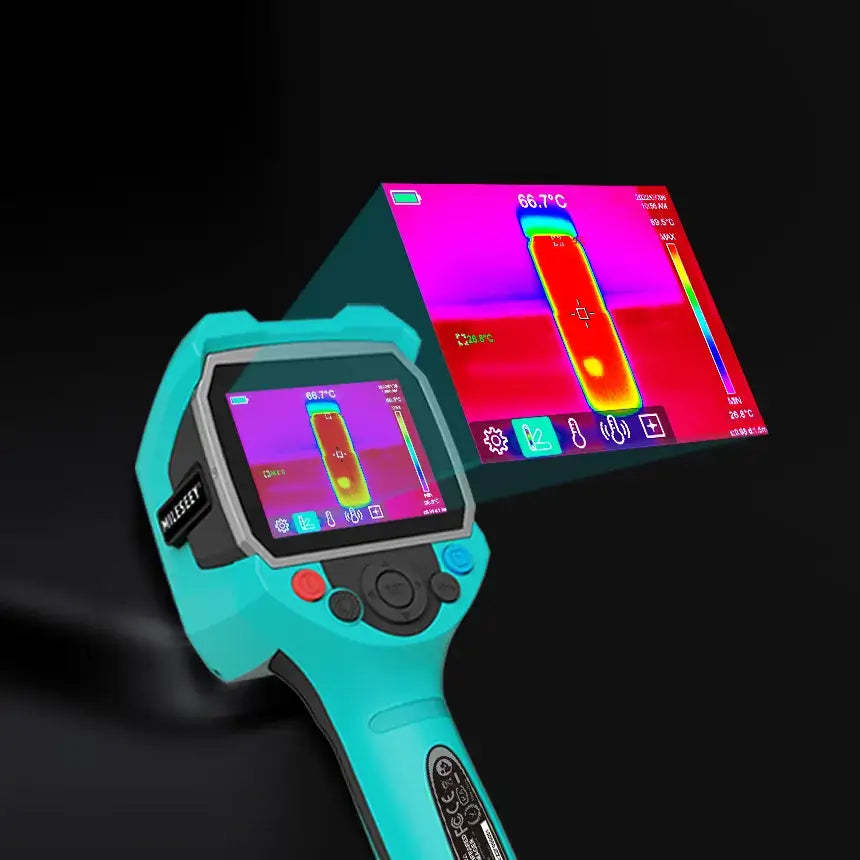
The TR256A also provides adjustable emissivity, automatic hot- and cold-spot tracking, high- and low-temperature alerts, and a 3.5-inch 640×480 display. Its 2× and 4× digital zoom can enlarge the view, but it is not additional native infrared resolution. Whether the model fits a task still depends on working distance, target size, expected temperatures, environment, and procedure.
If those documented characteristics match your shortlist, review the full MILESEEY TR256A thermal camera product information and Support material before deciding. For critical work, define an acceptance procedure around representative targets rather than relying on the specification sheet alone.
Frequently asked questions about NETD
Is a lower NETD always better?
Under comparable conditions, a lower NETD indicates greater thermal sensitivity. It is most valuable when the job depends on low-contrast detail. It does not compensate for insufficient resolution, unsuitable optics, poor focus, reflections, a target that is too small, or an inspection performed under the wrong conditions.
Can a high-sensitivity thermal camera measure temperature more accurately?
Not necessarily. Sensitivity and accuracy are separate specifications. Lower image noise can make patterns easier to see, while quantitative temperature work still depends on calibration, target properties, environmental inputs, spatial coverage, and the manufacturer's stated measurement conditions.
Does digital zoom improve NETD?
No. Digital zoom changes how existing image samples are displayed. It does not change detector sensitivity or add native thermal detail.
Choose sensitivity in the context of the whole job
NETD is most useful when it is treated as one part of a system. Begin with the smallest thermal contrast the task needs to reveal. Then check native infrared resolution, target coverage, working distance, focus, frame rate, temperature range, emissivity controls, and environmental limitations. A lower NETD can help make subtle patterns visible, but the credibility of the conclusion still comes from a repeatable inspection method and appropriate confirmation.