Long shifts can feel even longer when the only background sound is drills, saws, compressors, and machinery.
A traditional jobsite speaker can make work less monotonous, but it works best when the crew stays in one area. Earbuds are more portable, but they sit inside the ear and may reduce awareness of surrounding sounds.
A wearable jobsite speaker sits somewhere between the two: personal audio that moves with you, without putting anything inside your ears.
So which one actually makes sense on a jobsite?
Jobsite Speaker vs. Earbuds vs. Wearable Speaker
| Traditional Jobsite Speaker | Earbuds | Wearable Jobsite Speaker | |
| Best for | Fixed work areas | Personal listening | Workers constantly moving |
| Sound | Wide-area | Personal | Personal / near-field |
| Mobility | Low | Very high | Very high |
| Ear canal remains open | Yes | No | Yes |
| Calls | Secondary | Usually good | Can be a core feature |
| Crew audio | Easy | No | Possible with multi-speaker sync |
| Main drawback | Heavy and stationary | Can reduce environmental awareness | Less powerful than a full-size speaker |
For construction work, none of these is automatically “safe.”
A wearable speaker leaves the ears open, which can help workers remain more aware of coworkers, vehicles, and warning sounds than sealed earbuds.
Wearable speakers, earbuds, and traditional speakers do not replace required hearing protection or jobsite PPE (Personal Protective Equipment).
What to Look for in a Wearable Jobsite Speaker
-
AI Matters Most During Calls
The phrase AI-powered speaker can sound vague.
For a jobsite, one of the more practical uses of AI is call clarity.
Drills, wind, fans, generators, and machinery can make it difficult for customers, project managers, or suppliers to hear you.
GripSound Xmini uses SmartVoice AI processing with dual digital MEMS microphones to reduce background noise picked up by the microphone and emphasize the speaker's voice.
So its “noise cancellation” is mainly about:
Helping the person on the other end hear you more clearly.
It is not the same as active noise cancellation for music playback.
-15.png?w=512&h=306)
-
Weight and Wearability
A portable speaker sits on a table. A wearable speaker sits on you.
That makes weight much more important.
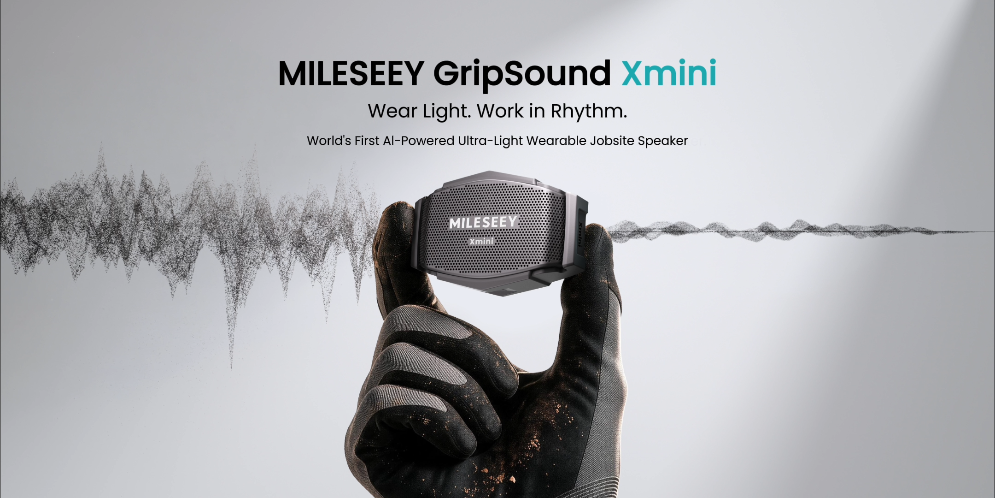
The GripSound Xmini weighs 38 g, so it is designed to feel more like part of your workwear than another tool you have to carry.
It can clip to a:
-
work vest
-
shirt collar
-
shoulder strap
-
chest pocket
-
cap brim
It also includes magnetic mounting for toolboxes, cabinets, vehicle bodies, ladders, and other metal surfaces.
For an ultra-light speaker, the goal should be simple:
Clip it on, start working, and stop thinking about it.
-0.png?w=1200&h=513)
-
Multi-Speaker Audio Can Work Better for Moving Crews
A normal jobsite setup is usually:
one large speaker → one fixed location
A wearable multi-speaker setup can work differently:
multiple workers → multiple small speakers → synchronized audio
Xmini supports Auracast multi-speaker synchronization, allowing several units to play together.
That can make sense for installers, maintenance crews, or tradespeople moving between different areas of the same job.
Another useful detail: when a call comes in, shared playback pauses while the phone conversation stays on the primary speaker instead of being broadcast across the whole group.
That makes a multi-speaker Bluetooth system more practical for real work rather than just party playback.
.png?w=750&h=320)
-
Personal Audio vs. Site-Wide Volume
A large construction speaker is designed to fill a work area.
A wearable speaker has a different job.
Instead of trying to make the entire site louder, it keeps audio close to the person wearing it.
Xmini uses a 2 W near-field audio design, which makes more sense for someone moving between rooms, ladders, trucks, and work zones than for a crew that wants one speaker covering a large open site.
Choose a traditional jobsite speaker if:
You want high volume across one fixed area.
Choose a wearable jobsite speaker if:
You want music and calls to follow you while you move.
.png?w=1200&h=567)
-
Battery Life Depends on Volume
Battery claims are only useful when the volume level is included.
For Xmini:
| Usage | Battery Life |
| 50% volume | Up to 10 hours |
| 100% volume | About 4 hours |
| Charging | ≤2.5 hours |
That means moderate near-field listening can cover most of a workday.
But if you expect to run an ultra-light jobsite speaker at maximum volume continuously, four hours may not be enough.
That is another reason wearable speakers are better suited to nearby personal audio than trying to overpower very loud machinery.
.png?w=750&h=413)
Example Jobsite Test Scenario
The following is a simulated test scenario for illustrating how a wearable jobsite speaker could be evaluated. It is not an actual measured Xmini test result.
Imagine an installer wearing the Xmini on a work vest for a typical shift:
| Test | What to Check | Result |
| Walk + climb stairs for 30 min | Does the clip move or pull on clothing? | × |
| Bend / crouch 50 times | Does the speaker stay attached? | √ |
| Play music around 50% volume | Is near-field audio clear without filling the whole room? | √ |
| Take a call near a running drill | Can the caller still understand the worker? | √ |
| Leave phone in toolbox and walk away | When does audio begin to break up? | ≥ 30M |
| Move speaker from vest to metal toolbox | Is switching between clip and magnet convenient? | √ |
This type of test is more useful than simply asking whether a speaker is “rugged” or “jobsite ready.”
It focuses on how the product actually fits a working routine.
Durability Still Matters
Jobsite equipment has to deal with more than normal indoor Bluetooth speakers.
Xmini is rated for:
-
IP67 dust and water resistance
-
up to 3 m drop resistance
-
-20°C to 50°C operating temperatures
-
raised physical buttons designed for glove-friendly control
Those specifications matter around sawdust, rain, dirty gloves, cold mornings, and accidental drops.
But specifications should still be treated as manufacturer ratings unless independently tested.
.png?w=750&h=413)
Who Should Choose a Wearable Jobsite Speaker?
A wearable speaker makes the most sense if you:
-
move around constantly during work
-
want music without earbuds
-
regularly take phone calls
-
prefer lightweight gear
-
want both clip-on and magnetic mounting
-
work with a mobile crew that may use synchronized speakers
Who Should Choose Something Else?
A full-size jobsite speaker is probably better if you need:
-
maximum volume
-
coverage across a large workshop or open site
-
all-day playback at very high volume
And if your job requires certified hearing protection, a wearable speaker does not replace earplugs or earmuffs.
Where GripSound Xmini Fits
GripSound Xmini is not trying to be a smaller version of a large jobsite radio.
Its strongest use case is different:
Keep music and clearer calls with the worker instead of leaving the speaker behind.
Its main features reflect that:
-
38 g ultra-light design
-
near-field 2 W audio
-
AI-assisted call noise reduction
-
dual MEMS microphones
-
clip + magnetic mounting
-
Auracast multi-speaker sync
-
IP67 protection
-
3 m drop rating
-
up to 10 hours at 50% volume
For mobile workers, that can make repetitive work feel less dull without adding another bulky piece of equipment.
For crews staying in one fixed area, a traditional jobsite speaker may still be the better choice.
.png?w=1066&h=775)
FAQ
Is a wearable jobsite speaker safer than earbuds?
It leaves the ear canal open, which may help maintain awareness of surrounding sounds. However, loud music can still mask warnings, vehicles, or coworkers. Always follow site rules and hearing-protection requirements.
Is Xmini a noise-canceling speaker?
Its AI noise processing is primarily designed to reduce background noise picked up during calls, helping the other person hear your voice more clearly.
Can multiple Xmini speakers play together?
Yes. Xmini supports multi-speaker synchronization, which can distribute audio across workers instead of relying on one central speaker.
Is 2 W enough for a jobsite?
For personal near-field listening, it can be appropriate. If you need to cover a large open area at high volume, a full-size jobsite speaker is the better option.
.png?w=800&h=800)
.png?w=800&h=800)